
Hunter
Design philosophy and key properties of Vanward suppressors
Vanward suppressors is 3D printed in grade 5 Titanium in one piece to achieve maximum strength and safety in combination with the lowest weight and noise reduction possible.
Vanward Hunter series is designed specifically for the hunter and shooter requirements.
Where noise and recoil reduction together with low volume/diameter and weight are the main drivers.
Vanward specific design
How suppressors work - or should work
-
The suppressor must have adequate volume and baffle design to;
a) Reduce the recoil by capturing the gasses as it expands , thus generating a force working in the opposite direction of the recoil forces
b) Reduce the speed of the gas expansion and to mix and generate turbulence in the gases to reduce the noise. -
The suppressor must have the mechanical properties to withstand all relevant factors from the use, including safety margins
a) Mechanical strength - both Yield strength and high fatigue stress resistance
b) High temperature resistance
c) Corrosion resistance -
Low weight
-
Minimum maintenance
For Vanward, only Titanium (and Inconel) is acceptable material to be used in suppressors and 3D printing is the only option to manufacture.
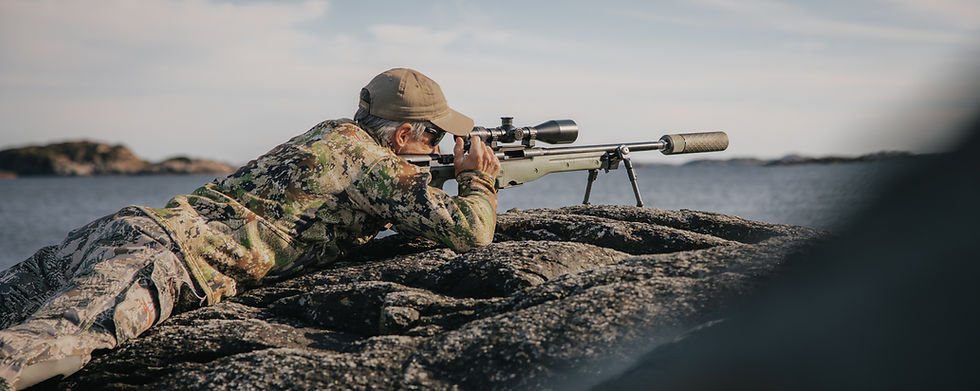
Acoustic and recoil reduction
Background and theory
-
The speed of sound is depending on temperature, air density/humidity and atmospheric pressure, where temperature is the most dominant factor.
-
At 20 deg. C the speed of sound is 343,3 m/s.
-
Sound is a form of overpressure in the air and is measured in dB
-
3 dB increase (or decrease) represent a doubling (or half) of the sound pressure level
-
To the human ear, a 10 dB change in the sound level will represent a doubling of the perceived loudness.
-
Typical noise level from an unsuppressed .30 cal. rifle is approximately 165 - 171 dB
-
Maximum SAFE peak sound level from a rifle is 140 dB (MIL-STD-1474D) at shooters ear.
-
Firearm sound is generated by:
- Muzzle Blast
- Bullet breaking sound barrier

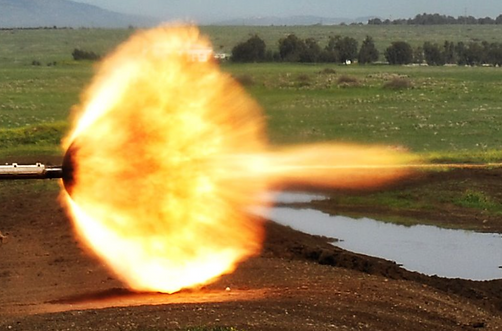
A typical .30 cal. cartridge fired in a standard barrel represents approximately:- Muzzle pressure at 850 bars, gas velocity of 900 - 1000 m/s and in total 150-170 liters of gas expanded to atmospheric conditions.
Firearm sound is generated by
Muzzle blast and supersonic crack from bullet (If not subsonic)
-
Muzzle blast - Primer and powder ignition together with sudden release of high pressure, hot propelling gases in bore creating a shockwave by the muzzle.

Sound of the bullet in flight
Breaking the sound barrier (ballistic crack) which is generated outside the weapon as long as the bullet flies faster than the speed of sound and cannot be addressed by a suppressor
This sound is very difficult to locate where it comes from as it is a continuous generated sound wave

Unsuppressed rifle vs suppressed rifle
